by Cathy Jones
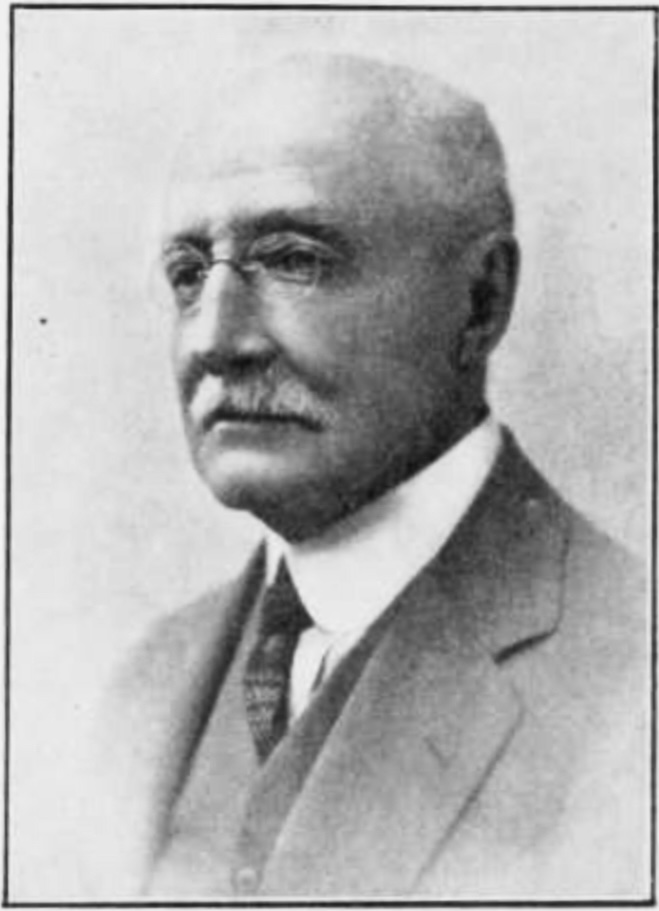
Harry Chambers Kent [1852-1938] was a notable architect in the late nineteenth and early twentieth century based in Sydney. Kent also had significant links to the Strathfield district.
He was President of the Institute of Architects in 1906-7 and during his forty-eight years of practice, he designed or was associated with over 670 buildings. He was a prolific architect and his designs span a wide range of building types including hospitals [eg Carrington Centennial Hospital at Camden 1890], private residences, commercial offices and banks, schools, extensions to Randwick Racecourse, churches and woolstores. Many of Kent’s designs are now heritage listed and at least two are on the State Heritage Register – the former CBC Bank [corner of George & Barrack Streets Sydney] built between 1921-25 and extensions to Mariners Church in 1927 [also known as the Mission to Seaman, 98-100 George St Sydney][i] designed in partnership with HH Massie.
Kent designed many buildings in Strathfield including Mount Royal in 1887 [now the Australian Catholic University], ”Agincourt’ (now Jesmond Nursing Home in Albert Road) in 1890, Dill McKay Institute for Blind Women in 1891 [Albert Rd, now the Catholic Institute of Sydney], Strathfield Town Hall [1923] and alterations to Strathfield Council building [1913] and first floor extensions to the Council Chambers [1921-23]. Kent also designed residential properties such as Inglenook 17 Margaret St for merchant George Bird in 1893 [demolished 2003] and Swanton Victoria St for grazier Stanley Vickery [demolished early 1970’s]. Another project he undertook in Strathfield was the design of the Camden Congregational College on Homebush Rd in the late 1880’s. Though Kent developed plans for a neo-Gothic building, a decision was taken in 1893 not to proceed with this project and the land was subdivided and sold for residential development[ii].
Kent’s community involvements in Strathfield
Harry Kent was also actively involved in community and civic activities in Strathfield. He was a member and organist of the Strathfield-Homebush Congregational Church [now Uniting Church – Korean Parish]. There is speculation that Kent was involved with the design of this Church, but to date it has not been substantiated and his papers make no mention of this project[iii]. Kent was one of the architects approached to design the Strathfield Council Chambers in 1887, but the tender was won by John Sulman, who submitted a lower price. However, Kent was later engaged by Strathfield Council to extend the Council Chambers with a first floor addition [1921-2] and design the Strathfield Town Hall [1923]. Harry Kent served as an Alderman on Strathfield Council from 1903 until 1905. The minutes note on 8 February 1904 that the newly-elected Mayor, Frederick Parsons, said Kent was offered the position of Mayor but declined noting that he intended taking a trip to Europe and ‘couldn’t do justice to the position’[iv]. Kent formally resigned as an Alderman on 31 January 1905 citing reasons previously stated[v].
Biography and Professional Achievements
Kent was born in Devonshire, England in 1852, the son of the Rev. Samuel Chambers Kent and his wife Emily Deacon. The family migrated to Australia in 1853 and settled in Sydney, where the Rev. Samuel Kent became Principal of the Camden Congregational College in Newtown and member of the first College Council along with stockbroker Josiah Mullens, retailer David Jones, stockbroker Samuel Thompson, the Rev. John West [editor of the Sydney Morning Herald] and Andrew Garran.[vi] Harry Kent received his education at Camden College and then studied for the degree of MA at University of Sydney in 1874. He was one of the few architects of his generation to have a University education[vii]. Prior to his graduation from University, he was articled to James Barnet, the Colonial Architect, and in 1873, articled to John Horbury Hunt, from whom ‘he acquired a love of good brickwork’[viii].
Despite his father leaving Camden College in 1872 and later defecting to the Church of England, Harry Kent maintained a life-long dedication to the Congregational Church and his connections within the Church do not appear to be affected by his father’s defection. Harry Kent later became a member of the Camden College Council and in 1929 published a book of sermons entitled ‘Lyric Thoughts and Laic Sermons’, many drawn from sermons he preached in the Strathfield-Homebush Congregational Church, during the illness of the Minister, the Rev. W Cunliffe-Jones in 1916[ix]. As a young man, Kent studied music and became an accomplished organist. For nine years was the organist of the Pitt Street Congregational Church, where he met Mary Louisa Elbury Jefferis, the daughter of the Minister, the Rev. James Jefferis, whom he married in 1886[x]. The Kent’s had three children: Gladys, Louise and Geoffrey[xi]. His daughter Louise noted that Kent continued his music throughout his life and was an organist for 52 years, including a long period at the Strathfield-Homebush Congregational Church[xii].
Kent’s Congregational connections provided him with assistance in his profession. Unable to find employment after graduation from University and as the son of a poor parson, he had limited financial resources to pay a premium to secure employment with an architectural firm. He sought assistance from Josiah Mullens and John Fairfax, both prominent Congregationalists[xiii]. Through Fairfax’s recommendation, he secured his first position with master builder John Young[xiv]. In a speech made in 1924, Kent spoke warmly of his experiences with Young, where Kent worked for over seven years. Kent said he became ‘conversant with all branches of the building trade…being employed on the Lands Office, St Mary’s Cathedral and other City buildings’ and ‘worked on the erection of the Garden Palace for the International Exhibition of 1879’[xv]. In his career as an architect, Kent was known for his extensive knowledge of building procedures and his fairness in dealings with builders, resulting in a large demand for his services from prominent builders[xvi].
In 1882, when he went into private practice, his first commissions included design of a city office block for Josiah Mullens [reputedly Eldon Chambers Pitt St Sydney] and a house Caerleon for John Fairfax’s grandson, Charles Fairfax, at Bellevue Hill. In 1888, when Kent was still a relatively young and emerging architect, Horbury Hunt attacked Kent in the Daily Telegraph newspaper for his ‘lack of interior planning’[xvii]. Hunt’s attack solidified the Sydney architectural community behind Kent and though the Institute Committee found in Kent’s favour, after lodgement of a complaint, Hunt never apologised[xviii]. After many years working alone, in 1889 Kent entered into partnership with Henry Budden and in 1912, architect Carlyle Greenwell joined the partnership. This partnership produced 150 buildings before its’ dissolution in 1919. Many future prominent architects were articled to Kent including William Hardy Wilson [1899-1904], S A Neave and HH Massie in 1911. Massie, a member of an influential banking, commercial and sporting family became his partner in 1919[xix]. This partnership, trading as Kent & Massie, lasted until Kent’s retirement from active involvement in 1930. As Cable notes, the end of the Great War was a boom time in building and Kent & Massie were able to secure many commercial commissions including the Bebarfalds store [later Woolworth’s] in George St Sydney[xx]. However, their principal client was the Commercial Banking Company of Sydney [which was acquired by the National Bank in 1981]. Kent & Massie designed the former CBC head office on corner of George & Barrack St Sydney [now on the State Heritage Register] and a series of country banks at Newcastle, Scone, Cessnock and Parkes.
Kent traveled on a frequent basis to Europe and his travel experiences influenced much of his thinking on hospital and town planning. During his career, Kent designed a number of hospitals and sanatoriums including the Children’s Hospital at Camperdown. For many years, he was honorary Secretary of the Hospital. Thirty years after the death of Harry Kent, his daughter, Mrs Louise Perry, donated his papers to the School of Architecture at University of NSW in 1968. She also submitted a short biography of her father including a short but highly illustrative story about her father’s personality noting that ‘he rode a bicycle to Strathfield Station each day with his trousers neatly clipped round his ankles to avoid any grease from the chain or pedals’ and described her father as living in ‘a gracious age and [he] was a gracious person in that age’.
References
20th Century Architects of Significance, New South Wales Region
Cable, Ken, ‘The Congregational Factor’, contained in 46-48 Beresford Rd Heritage Assessment by Tropman & Tropman Architects, February 2001
Garrett, J. & Farr, L W., Camden College: A Centenary History, Camden College Glebe Sydney, 1964.
Hatossy, Bela., Harry Chambers Kent, [B Arch thesis], University of NSW, 1974.
Kennedy, R., ‘The Strathfield-Homebush Congregational Church’, SDHS Newsletter Vol.8 No.7 March 1986
Kent, H., ‘Reminiscences of Building Methods in the Seventies under John Young’, Architecture, pps 5-6, November 1924.
Land title search of Woodstock – notes dated 21 August 1984. Author is unknown but probably Reg Kennedy.
Perry, Louise, Notes on her father Harry Kent upon donation of his papers to the School of Architecture, University of NSW, 1968.
Sands Sydney Directory, published by Johns Sands until 1932/3.
Strathfield Council meeting minutes 1903-1905 and correspondence file 1905.
[i] Information from search of heritage inventory records on http://www.heritage.nsw.gov.au. Much information on these records do not contain architectural details and ability to search is restricted by the design of the search facility, therefore there are probably more heritage items associated with Kent, but the information is not yet easily available.
[ii] Cable, K ‘The Congregational Factor’ 2001; also Garrett & Farr, Camden College, 1964, p27.
[iii] Kennedy, R ‘The Strathfield-Homebush Congregational Church’, Vol.8 No.7 March 1986
[iv] Strathfield Council minutes 3 February 1903
[v] Strathfield Council inward correspondence, item 14091 dated 31 January 1905
[vi] Garrett & Farr ‘Camden College: A Centenary History’, 1964
[vii] Cable, K ‘The Congregational Factor’, 2001
[viii] Hatossy, Bela., Harry Chambers Kent, [B Arch thesis], University of NSW, 1974.
[ix] Garret & Farr, ‘Camden College: A Centenary History’, pages 26 & 34, 1964
[x] Mrs Louise Perry 1968
[xi] Information from http://www.bdm.nsw.gov.au. Also Hatossy [1974] notes that Kent’s son died at Gallipoli. I checked the records at the Australian War Memorial and Geoffrey Kent returned from action in 1919. I couldn’t find any other reference to another son on records I searched. Curiously, Hatossy notes that Geoffrey Maule Kent is executor of Harry Kent’s will in 1938.
[xii] Mrs Louise Perry 1968
[xiii] Kent, H, Architecture, 1924
[xiv] Kent 1924
[xv] Kent 1924
[xvi] Hatossy, Bela., Harry Chambers Kent, [B Arch thesis], University of NSW, 1974.
[xvii] Cable, K, ‘The Congregational Factor’, p8, 2001; also Hatossy, B, 1974
[xviii] Hatossy, Bela., Harry Chambers Kent, [B Arch thesis], University of NSW, 1974.
[xix] Cable, K ‘The Congregational Factor’, 2001
[xx] Cable 2001
(c) Cathy Jones 2008. Pursuant to the provisions of the Copyright Act 1968, no permission is given to any person to reproduce any work. Existing publications do not assign or imply any ownership by any other person by the author. No permission is given by the author for any commercial advantage to any person or organisation.
 Strathfield Heritage
Cathy
Congratulations on your work with this website – it is invaluable. I believe you may have the wrong spelling for the Jefferis family in this article. In the Camden College history it is James Jefferis, and not Jefferies as you have it. This article about Harry Jefferis may also be of interest to you as he was not only Kent’s brother-in-law but was articled to him. http://www.architecture.com.au/i-cms_file?page=13453/WH_Jefferis_for_AIA_WA.pdf Sorry to nitpick but you might like to change the spelling of Bebarfalds. http://www.hht.net.au/discover/highlights/online_exhibitions/sydneys_home_furnishing_stores,_1890-1960/bebarfalds Keep up the good work – I don’t think there is a Sydney suburb better served in terms of local history on the web.
Scott
LikeLike
Scott
Thanks for the feedback, I’m glad you like the site. I’ve made changes as suggested to the article. Also happy to get suggestions for articles or additional information.
Cathy
LikeLike
Hi Cathie,
I’m a direct lineal descendant / relative on Samuel Chambers Kents direct line. He was my great great grandfather via his first daughter from his second marriage to Charlotte Eliza Chapman/Wilson (1st m.1853 to Andrew Wilson) in 1869 at Camden College in Newtown, Sydney NSW, Australia.
If you genealogically track my direct line (James)…and you don’t have go back too far…bingo!…it’s there.
So Harry Chambers Kent would have been my father’s grandmother’s 1/2 brother i.e. his great uncle and my grandfather Frederick Ross James’s 1903-1975 RN RAN OBE uncle.
Harry Chambers Kent’s mother was of course Emily Deacon (died Newtown Sydney 1868). He was the second child of Reverend S C Kent’s first marriage to Emily Deacon / Kent in Lambeth, Surrey, England in March 1850. One of Emily’s grandfathers had been a medical doctor in Leichestershire, England. Her mother’s maiden name was Charlotte Maule. Her father was Frederick Deacon. These would be Harry Chambers Kent’s maternal grandparents.
Reverend Samuel Chambers Kent married for a third time in Melbourne on 10th of January 1881 (Christ Church St Kilda) to Elizabeth Raymond Buxton (she was born in Kent, England to a Canadian – Ontario? Elizabeth Jane Buckhurst born mother and English father Richard Raymond Buxton) and died in 1896. There were unfortunately no descendants resulting from this marriage. This marriage certificate revealed that Samuel Chambers Kent 1826-1911 had been born to Susan Chambers (School Head Mistress) and Thomas Kent in Wangford near Southwold, Suffolk, England. (Wangford Web). I subsequently found out that he had been an only child and dedicated to the Independent Church fairly early in his life. A grandmother in Suffolk was Mary Leavold (hence the inclusion of the name for one son in 1865) and another uncle/relative called William Kent was the mayor of Colchester, England.
My grandfather had a strong connection to Harry’s sister Edith Mary Leslie (nee Kent) who died in Shorefleet? Surrey, England in 1942.WW2. She was the person largely charged with the responsibility of bringing up the five S C Kent daughters (including a two day old infant Charlotte Eliza Kent 1879-1962) after their mothers untimely death in 1879. So she took on the roll of surrogate/step mother to the 5 second marriage Kent daughters and then ultimately grandmother/ beloved aunt to Fred and his siblings. I spoke to one of her (Edith Leslie’s) grandsons… who currently lives in England, who happily volunteered this information. Edith attended Fred’s (Jimmy’s)1932 wedding in Melbourne, Vic, Australia. A big ask at her age and stage of life – having to journey from England to Australia by ship. She even signed her name on the back of the marriage certificate…just to prove a point…I guess? The marriage was held in the Collins St Congregational Church in Melbourne…curiously enough…not the Church of England.
Apparently when my grandparents were in England (Plymouth/Dartmouth/Wembry) in Devonshire from 1936-1942 he (Grandfather Fred R James) visited her (Aunty Edith) on a fairly constant basis, as did my grandmother Claudina James 1906-1964 (nee Callaway). The dedicated connection was there. Again her direct descendant shared this information.
As my maiden name was James…my Y DNA if you like…then this is my direct line.
Charlotte Maidment Kent 1870-1929 Warrandyte South, Vic, Australia (mistake by informant John Alison Funerals on her death certificate had surname “Smith” instead of James-all other details correct including her parents, children, birthplace etc), was my father’s paternal grandmother. A child of her’s who died in 1900 in Melbourne was named Harold Kent James. So there’s yet another clue.
Her (Charlotte Maidment Kent / James) marriage certificate also came with an added bonus…only three weeks after her marriage to Charles Frederick James at St Silas Church of England in Albert Park Melbourne in October 1897 was the marriage (also performed by her father the Rev S C Kent) of her brother (1/2) Clergyman – Arthur Leavold Kent 1865-1931 another (younger) brother of Harry Chambers Kent. Both entries/certificates appeared on the same page. (Genealogically speaking…that’s got to make you smile:)
He (A L Kent) was in Warragul, Vic, Australia and oversaw the planning / building of St Paul’ s Anglican Church Warragul from 1908-1914. His children attended school in Warragul.
These days I’ve put it all on ancestry.com.au, including all the genuine certificates backing up the information…I also met up with a Kent on Frederick Deacon Kent’s 1851-1925 (older solicitor brother of Harry) direct line back in July this year 2012 …that was extremely interesting. He resembled my son James and a few other relatives on this line.
So my interest in Harry Chambers Kent and his activities is an extremely real and genuine one, after all there was and is, clearly a connection.
Enjoyed the article…well written…wish that I could
write like this…just haven’t got the organised mind.
Kind Regards and Best Wishes-Elizabeth
LikeLike
Elizabeth
Thanks for your post which contains a huge amount of information the Kent family. I am sure that this will be interesting to other people also. Thanks for taking the time to provide this information.
Cathy
LikeLike
Hello Elizabeth 🙂
I am also a descendant! I have been trying to find a contact point for you for a few years now… I’ll see how this one goes!
My line goes;
Thomas Kent
Samuel Chambers Kent
Harry Chambers Kent
Arthur Leavold Kent
Frederick Arthur Kent
Robert Frederick Kent
Deborah Louise Kent
Laura Kilpatrick (me)!
I’d be interested in conversing with you online or in person if you are also?
Ps: Cathy very interesting read thank you 😊
LikeLike